Crowns & Bridges
Crowns & Bridges
Orizin NexxZr T
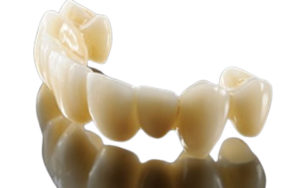
NexxZr T is a translucent zirconia for individual aesthetics — a dental zirconia for monolithic restorations from single tooth to multi-unit bridges. It impresses with a perfect balance of translucency and strength for aesthetic all-ceramic restorations, and the soft material before sintering ensures an effortless manufacturing process.
Technical Data
- Biaxial flexural strength 1270 MPa.
- 42% translucency.
- Type II, class 5.
- Linear thermal CTE 10.1 (25–500 °C).
- White discs can be customized by brush or dipping infiltration, or processed as a preshaded variant (16 A–D shades, 3 bleach shades).
Lithium Di-Silicate (E-max) Restoration
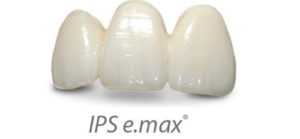
A popular choice for dental crowns and veneers thanks to their strength, durability, and esthetic properties. They combine high flexural strength and translucency, allowing natural-looking restorations in both anterior and posterior regions.
Key Features
- High strength: flexural strength of ~360–400 MPa — one of the strongest dental ceramics.
- Esthetics: excellent translucency lets light pass through, mimicking natural teeth.
- Durability: resistant to wear and tear, suitable for various dental applications.
- Versatility: can be fabricated by both heat-pressing and CAD-CAM techniques.
- Minimally invasive: thinner walls allow more conservative tooth preparation.
Dentsply Sirona / Cercon
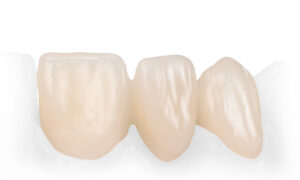
Cercon ht ML is a hybrid zirconia multilayer combining high strength and natural aesthetics — from a single crown to a 14-unit bridge with no nesting restrictions, even for wide-span bridges. One disc carries a gradient from 1200 MPa in the dentin up to 750 MPa in the incisal; nesting the restoration in the upper part of the disc gives the optimum aesthetic result. Easy to nest, with the same sintering programmes for all Cercon discs — just glaze and go.
Advantages
- Incisal layers are identical across disc sizes (only dentin thickness varies), making nesting extra easy.
- Improves productivity with reproducible results while saving milling, sintering, and glazing time.
- Same sintering programmes for all Cercon zirconia discs.
- Speed sintering in less than 3 hours for all Cercon zirconia discs.
- QR-code scanning for easy use in inLab MC X5 (from CAM software v20.0.1).
- Positioning aid for safe repositioning of the blank.
Veneer
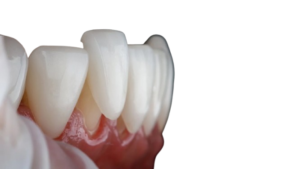
A thin layer of material, typically porcelain, bonded to the front surface of a tooth for cosmetic improvement — a restoration that combines the characteristics of both veneers and crowns. Veneer crowns balance aesthetics and strength, preserving more natural tooth structure than a traditional crown, and are a great option for restoring front teeth where aesthetics matter.
Advantages
- Preserve more natural tooth structure than traditional crowns.
- Offer a more natural-looking aesthetic.
- A good option for restoring front teeth.
Disadvantages
- May not be as durable as traditional crowns.
- May require more frequent replacement than traditional crowns.
IPS ZirCAD Prime Esthetic
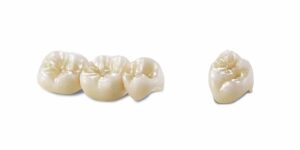
A masterpiece for greater efficiency: IPS e.max® ZirCAD Prime blocks reach the next level of speed, strength and esthetics in monolithic zirconia crowns. Sinter crowns in just 15 minutes with the Ivoclar Programat® CS6 — reliable, esthetic results without any loss of strength.
- Quickly sinter restorations in ~15 minutes using a furnace such as the Programat CS6.
- Robust and enduring: flexural strength of 1,100 MPa lets you minimize crown wall thickness to 0.8 mm.
- Natural, esthetic results from a smooth shade/translucency progression — dentin (3Y-TZP) to translucent incisal (5Y-PSZ).
- Place with conventional cement (e.g. ZirCAD® Cement), or use a self-adhesive/adhesive protocol.
PFM (Porcelain-Fused-to-Metal)
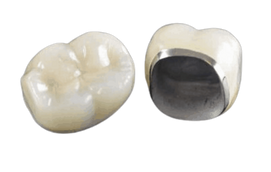
A PFM crown combines the strength of a metal substructure with the aesthetics of porcelain.
- Metal substructure: a core of metal alloy (nickel, chromium, cobalt, or palladium) provides strength and durability.
- Porcelain veneer: a layer of porcelain fused to the metal gives a natural, tooth-colored appearance.
- Strength & durability: withstands the forces of chewing and biting.
- Aesthetic appeal: the porcelain can be shade-matched to surrounding teeth to blend in naturally.
Metal
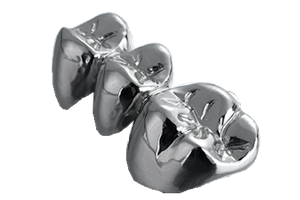
Metal crowns are exceptionally strong and can be made from stainless steel or various metal alloys. Because they can’t be matched to the color of existing teeth, they aren’t used as often as they once were — but they’re still ideal for molars far back in the mouth.
They wear down slower than porcelain crowns and very rarely break from biting or chewing. There’s some risk of corrosion, though most alloys used are highly corrosion-resistant. A common alternative is porcelain-fused-to-metal — the strength of metal with a color-matched porcelain overlay (though the porcelain may eventually chip, and a dark line can show at the gumline).
Gold
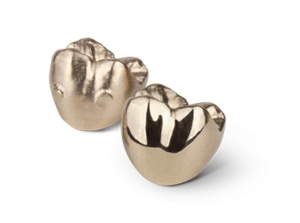
Gold dental crowns are durable restorations used to cover and protect damaged teeth, typically made from a gold alloy.
- Strength & durability: highly resistant to wear, fracture, and corrosion — long-lasting and ideal for high-force biting areas.
- Preservation of tooth structure: typically requires less tooth preparation, helping preserve the natural tooth.
- Biocompatibility: well-tolerated in the mouth, without reactions to surrounding tissues.
- Aesthetics: not as natural-looking as other materials, but a viable option — especially for back teeth.
Inlay / Onlay
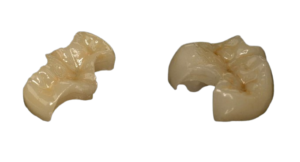
Inlays and onlays fill cavities and are cemented in place — an alternative to a direct restoration (composite, amalgam, or glass ionomer) built up within the mouth. They’re used in molars or premolars when a tooth has too much damage for a basic filling but not enough to need a full crown.
- An inlay incorporates the pits and fissures of a tooth, mainly the chewing surface between the cusps.
- An onlay covers one or more cusps; if all cusps and the entire surface are covered, it becomes a crown.
- Both are indirect restorations — inlays sit within the body of the tooth (no cuspal coverage), while onlays cover both the body and cusps.
Interested in this service?
Send us your case or get in touch — our team replies within 2 hours during working hours.